

















FRP (Fibreglass Reinforced Polymer), commonly known as GRP or GFRP, is a composite material consisting of:
- a thermosetting polyester resin matrix
- a reinforcement made of continuous glass fibres
The resin matrix ensures high corrosion resistance, while the glass fibre provides high mechanical strength, giving the composite chemical and mechanical properties that make it suitable for many applications, from industry to construction and infrastructure.

THERMOSETTING RESINS: THE FRP MATRIX
Thermosetting resins are a class of polymers that, once cured by heating or chemical reaction, form a rigid and irreversible three-dimensional structure. Unlike thermoplastic resins, which can be remelted several times, thermosetting resins cannot be reshaped after the curing process.
Thermosetting resins consist of reactive monomers or prepolymers that, in the presence of heat, catalysts or curing agents, form cross-linked covalent bonds.
Polyester resins are formed by the reaction (esterification) between two types of monomers: a polyacid and a polyalcohol (glycol). The ester bond (-COO-) is formed. The presence of “unsaturations” (C=C double bonds) is essential for curing.
This results in a polymer dissolved in a reactive monomer (usually styrene).
TYPES OF THERMOSETTING RESINS USED IN FRP
The main polyester resins used by M.M. in the production of FRP are:
- Orthophthalic Resin
The standard and most common resin, based on the use of phthalic anhydride. A good compromise between cost and performance. - Isophtalic Resin
Offers greater chemical resistance than orthophthalic resin. Uses isophthalic acid as the acid component. - Vinyl ester resin
Has a hybrid chemical structure between epoxy and polyester resin. It is the most resistant and ideal for highly corrosive environments.
Ranking of resins by chemical resistance:
VINYLESTER > ISOPHTHALIC > ORTHOPHTHALIC
This hierarchy is directly linked to the vulnerability of ester bonds. Vinyl ester resins have fewer of these bonds and they are protected within the main chain, offering maximum protection and making them the ideal choice for the most severe applications.
GLASS FIBRES: THE REINFORCEMENT IN FRP
Reinforcements for the polymer matrix are typically glass fibres. Glass fibres are produced through a melt-spinning process using raw materials (silica sand, limestone, kaolin, etc.) at high temperatures of about 1300-1500°C.
Types of glass fibres
- E-glass (“Electrical”): The most widely used type. Made of calcium-aluminium-borosilicate. It offers good mechanical and electrical properties at a competitive cost.
- S-glass (“Strength”): Characterised by a high silica and alumina content. Developed for applications requiring higher tensile strength, elastic modulus and high-temperature resistance than E-glass..
- C-glass (“Chemical”): offers excellent chemical corrosion resistance thanks to its high calcium and boron oxide content. Specific for aggressive chemical environments. Excellent corrosion resistance.
Glass fibres are available in different forms, suitable for various production processes
- Roving
Bundles of continuous filaments, ideal for filament winding and pultrusion.- Mat (stuoie)
Layers of randomly oriented fibres (chopped strand mat) or oriented fibres (stitched mat), often used in hand lay-up or RTM.- Fabrics
Fibres woven in different patterns (plain, twill, satin) to obtain specific mechanical and directional properties.- Chopped fibers
Fibres of defined length, used for injection moulding or compounding.

PROPERTIES OF FRP

High strength-to-weight ratio

Mechanical properties of fibreglass

Thermal properties of FRP

Fire behaviour

Resistance to chemical and environmental agents

Electrical properties of FRP

Hygroscopic behaviour

Durability and ageing
HIGH STRENGTH-TO-WEIGHT RATIO
One of the most important qualities of FRP is its excellent ratio between mechanical strength and specific weight. Thanks to glass-fibre reinforcement, the material has tensile and flexural strength comparable to some metals, while maintaining a much lower density. This makes it possible to create lightweight yet robust structures, with major advantages in terms of handling, reduction of static and dynamic loads, and lower transport and installation costs.
Comparison with other materials*
| Material | Tensile strength (MPa) | Density (g/cm³) | σ/ρ ratio (MPa·cm³/g) |
|---|---|---|---|
| Steel | ~500–800 | ~7,8 | ~64–103 |
| Aluminium | ~300–550 | ~2,7 | ~111–204 |
| GFRP | ~400–1200 | ~1,5–2,0 | ~200–800 |
Mechanical properties of fibreglass
The mechanical strength of fibreglass – FRP depends on the combined effect of the glass-fibre reinforcement content and orientation, as well as on the type of resin and the accuracy of processing. As the percentage of glass reinforcement increases, both tensile and flexural breaking load increase, along with impact resistance.
Regarding fibre orientation, maximum strength is achieved when all filaments are arranged parallel to one another (unidirectional layout); if the filaments are arranged in equal measure at right angles to each other, strength is lower but still considerable (orthogonal layout); if the filaments have no preferential orientation, strength is equal in all directions (isotropic layout).
The more ordered the fibre arrangement, the higher the achievable glass content and, consequently, the mechanical strength.
FRP offers good impact resistance, thanks to the fibres’ ability to absorb energy and distribute stress. Unlike steel, which can undergo permanent deformation (plastic phase), FRP does not deform permanently. FRP has good surface hardness and a fair resistance to abrasive wear, making it suitable for structural applications and components subject to moderate mechanical stress. The material also shows good fatigue resistance, especially when the fibres are oriented in the direction of the cyclic stresses.
Thermal properties of FRP
FRP has low thermal conductivity, typically between 0.2 and 0.4 W/m·K, depending on the glass-fibre percentage and orientation. This makes it an excellent thermal insulator compared with metals and alloys (k = 36–54 W/m°C), which is why it is used in applications requiring reduced heat transmission.
The linear coefficient of thermal expansion (CTE) is influenced by fibre content and orientation, being lower in the fibre direction. A significant comparison can be made with steel: the linear thermal expansion coefficient of FRP is 1.5×10⁻⁵/°C, compared with 12×10⁻⁶/°C for steel. This is highly relevant both at the design stage and during installation, particularly when creating joints.
The heat distortion temperature (HDT) of FRP varies according to the type of resin. Gratings retain their mechanical properties under continuous exposure at temperatures up to 105 °C (vinylester resin).
Fire behaviour
For polyester resin composites, the polymer matrix is the main factor responsible for fire reaction, being an organic and combustible material. Glass fibres, being inorganic, do not burn, but their mechanical integrity can be compromised by high temperatures. The fire behaviour of polyester resin composites can be significantly improved through the addition of flame retardants. These additives act through various mechanisms to inhibit combustion. M.M. uses aluminium hydroxide as a flame retardant, which decomposes at around 180 °C, absorbing a significant amount of heat in the process and releasing water vapour. In addition to acting as a fire retardant, it is highly effective as a smoke suppressant. No halogens are used.
M.M.’s IFR gratings are classified as Bfl-s1 according to EN 13501-1. IFR gratings have also been assessed for the dripping parameter, which describes the loss of molten droplets or the production of burning particles before and after combustion, achieving a d0 rating, i.e. no dripping.
Resistance to chemical and environmental agents
One of the most advantageous characteristics of FRP is its high corrosion resistance. This material is widely used as an alternative to steel in aggressive environments, such as chemical plants and infrastructure exposed to saline conditions or weathering.
In metals, corrosion is an electrochemical process in which the material tends to revert to a more stable form (such as an oxide). Polymers do not “corrode” in this sense but undergo a chemical degradation process. Agents such as acids, bases, solvents, or even water can attack the polymer’s chemical bonds, breaking the chains and weakening the material.
In composites, the dense network of covalent bonds creates a highly stable and compact structure (three-dimensional network). For an aggressive chemical agent, penetrating this barrier and finding a weak point to attack is extremely difficult. The very nature of the network makes the material insoluble. While a non-cross-linked polymer can be “dissolved” by a suitable solvent, a thermoset can at most undergo slight swelling but will not dissolve.
Electrical properties of FRP
Fibreglass products have dielectric characteristics that make them excellent electrical insulators.
Tests on surface resistivity and resistance (Rs) and volume resistivity and resistance (Rt), safety resistivity and resistance to earth (human body model), and dielectric strength at rated voltage have shown a resistivity greater than 200 MΩ and a current absorption of around 300 μA: the material can therefore be classed as an excellent insulator, compliant with safety standards.
Hygroscopic behaviour
Fibreglass – FRP has a moderate water absorption capacity, mainly influenced by the hygroscopic nature of the polymer matrix. Water absorption can range between 0.1% and 1.0% by weight, depending on environmental conditions and resin type, affecting certain mechanical properties over time.
Durability and ageing
Fibreglass – FRP shows good long-term durability, retaining its physical and mechanical properties even after years of exposure. Stabilising additives or protective coatings can be added to improve colour stability under UV exposure.

WHAT PRODUCTION TECHNOLOGIES DOES M.M. USE?
FRP gratings: the production process
M.M. produces FRP gratings using two main technologies:
- RTM (Resin Transfer Moulding), i.e. injection moulding
- HLU (Hand Lay Up)
In both cases, the process is based on laying glass-fibre roving inside a mould. The fibre is arranged to form a grid, overlapping several layers:
- in RTM technology, the fibre is laid dry
- in HLU technology, it is already impregnated with resin
Once laying is complete:
- in RTM production, the resin is injected into the mould.
Injection must be slow and controlled to ensure complete impregnation of the fibres;- in HLU production, resin is poured to fill the mould.
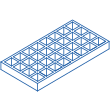
The finished grating consists of a monolithic grid of beams. The beams are orthogonal to each other and have the same mechanical strength.
FRP Profiles: the pultrusion technology
The production of FRP profiles is based on an industrial technology called pultrusion (from pull + extrusion), i.e. a traction extrusion process.
This technology makes it possible to continuously produce composite products, even with a high reinforcement percentage, in constant, simple or complex cross-sectional shapes.
The pultrusion process:
- glass fibres are pulled by a mechanical system through an impregnation bath, where they absorb the thermosetting resin;
- the impregnated fibres are pulled into a heated mould, where polymerisation takes place;
- the final shape is given by the shaped die of the mould;
- the component exits solidified, without being pushed, but thanks to the continuous pulling force applied.
COMPARISON BETWEEN METAL GRATINGS AND FRP GRATINGS/STRUCTURES
Metal gratings, like various steel structures, are probably the best-known type. Long used above all because they require a low initial investment, metal gratings and structures have several disadvantages that are not found in equivalent FRP products, especially when considering their full service life.
HOW MUCH DOES FRP COST COMPARED WITH METAL?
Unlike FRP gratings and structures, metal products involve:
- high cutting/shaping costs
- high installation costs
- maintenance costs due to poor chemical and atmospheric resistance
- higher transport costs due to the greater weight of the material
- higher grounding costs where required because of electrocution risk
- environmental cost linked to the possible release of hazardous substances.
- safety-related cost, as they do not have an anti-slip surface

