

















From industrial to outdoor: M.M.’s versatile solutions
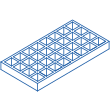
The use of M.M. gratings and pultruded profiles has greatly expanded its boundaries, moving from exclusive use in industrial spaces to application in outdoor environments. M.M.’s wealth of experience, combined with the technical performance of FRP – Fibreglass Reinforced Polymer – products, gives rise to solutions that are not only effective and functional, but also aesthetically appealing. Ease of installation and maintenance-free design make FRP products even more attractive.

Resistance to weathering
Resistance to humidity, thermal shock, brackish environments and weathering in general makes M.M.’s FRP products particularly suitable for use:
- in ports and marinas, as well as on inland waterways (rivers, lakes, lagoons, canals), for building fixed or floating jetties, piers, mooring quays, refuelling stations or barges, marine work or service stations;
- poolside and in access areas to water park slides, for creating anti-slip walking surfaces suitable for bare feet thanks to the special Q-PAINT finish, which is resistant to detergents, impact and scratches, with reduced colour fading;
- on pedestrian and cycle bridges, for creating durable, lightweight decking;
- on beaches, for temporary, removable structures such as beach gazebos that need to be dismantled during the winter season;
- in mountain areas characterised by the presence of snow and ice, for the development of access ramps to ski lifts and reception/refreshment points.
Structural use of composite materials
Pedestrian and cycle bridges made of composite material are solid, lightweight and corrosion-resistant structures.
They represent a cost-effective alternative to traditional materials such as concrete, steel or wood.
FRP proves to be an ideal choice for hostile environments, such as those near brackish or fresh water, in natural settings with variable weather conditions, and on walkways that require the use of de-icing salt.


Bridges entirely in FRP
I ponti M.M. completamente in vetrM.M. bridges made entirely of FRP include:
- decking
- parapets
- substructure, also in FRP
Designed for pedestrian or cycle use, they are calculated to withstand a load of 5 kN/m². The bridges are custom-designed based on span length, width and required load, and can use either a beam substructure or a lattice beam substructure. The weight, including the anti-slip decking, is generally between 60 and 80 kg/m².
Hybrid bridges: steel and FRP
A hybrid FRP bridge typically comprises:
- steel beam substructure
- FRP decking
The strength of steel allows for long spans, while the durability of FRP ensures corrosion-resistant, anti-slip decking.


RESISTANCE TO BRACKISH ENVIRONMENTS

WEATHER RESISTANCE

ANTI-SLIP CHARACTERISTICS

EASE OF INSTALLATION

NO MAINTENANCE

DURABILITY
Case history


