








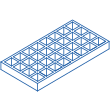




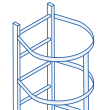





M.M.’s FRP – Fibreglass Reinforced Polymer – gratings and pultruded profiles can be used to build service structures for intake works, treatment plants for water fit for human consumption (potable water), conveyance works (drains, vents, hydraulic isolation or disconnection works, storage works, elevated sections, underpasses) and urban reservoirs.

Suitability for contact with potable water: full certification
Safety ladders (vertical ladders and stairways), walkways, platforms and parapets are made with pultruded profiles and moulded FRP gratings in the special “ACS” formulation (Attestation de Conformité Sanitaire), designed in accordance with the EN ISO 14122 standard and tested for use in direct contact with potable water.
In France, the Directorate General for Health has issued M.M.’s potable water solutions with the ACS sanitary conformity certification; in Italy, their use has been authorised by the Ministry of Health; and in Poland, the National Institute of Public Health – National Institute of Hygiene has issued the hygiene certification attesting to the sanitary conformity of M.M.’s gratings and profiles.
FRP structures for the water supply service
FRP structures suitable for potable water can be easily installed in water towers, collection tanks and aqueduct inspection manholes, even in direct contact with potable water.
FRP solutions for desalination plants
For installation near the sea, environment characterised by the presence of brackish water, and for treating residual substances (brine discharge), FRP gratings and structural steelwork are the ideal solution for those seeking a way to overcome the challenges of corrosion and ensure greater durability, reducing the maintenance costs of desalination plants used to produce potable water. These plants form part of the planning under Directive 2000/60/EC, which establishes a framework for Community action in the field of water policy, positioning itself as a new measure aimed at meeting human water needs.


CHEMICAL RESISTANCE

WEATHER RESISTANCE

ANTI-SLIP CHARACTERISTICS

EASE OF INSTALLATION

NO MAINTENANCE

DURABILITY

ACS
SANITARY CONFORMITY CERTIFICATE
Certifies that materials in contact with potable water do not contaminate it or alter its health and hygiene properties
Case history


